 ultimate-guide
How to Assess Tree Health: A Complete Guide
Table of Contents
- How to Assess Tree Health: A Framework for Homeowners
- Visual Inspection of Foliage and Canopy Density
- Signs a Tree Is Dying: Recognizing Critical Symptoms
- Trunk, Bark, and Root System Assessment
- Tree Disease Identification Guide and Fungal Signs
- Arborist Tree Inspection Cost and When to Call a Professional
- Post-Storm Assessment and DIY vs. Professional Risk Thresholds
- Frequently Asked Questions
Last Updated: October 4, 2026
How to Assess Tree Health: A Framework for Homeowners
Learning how to assess tree health is a practical skill for property owners. A healthy tree provides shade and increases property value; a failing tree becomes a liability that can drop limbs or topple during storms. Early detection makes the difference.
Most homeowners wait until a tree looks obviously dead to act, leaving removal as the only option. This guide shows you how to spot trouble early, understand what you're seeing, and know when to call a professional versus handle a minor issue yourself.
Visual Inspection of Foliage and Canopy Density
The canopy is your first diagnostic tool. A healthy tree displays full, dense foliage with minimal sky showing through the crown. Gaps and thin patches signal problems.
Crown dieback occurs when branches at the top stop producing leaves while lower branches still do, indicating the tree struggles to transport water and nutrients upward.
Canopy density matters: a tree with less than 50% foliage coverage has lost significant photosynthetic capacity. Walk around the tree and look for dead branches mixed with living ones, dead wood is brittle, gray, and lacks buds or green growth.
Foliage chlorosis (yellowing of leaves) indicates nutrient deficiency or stress. Yellowing in spring or summer is concerning; fall yellowing is normal.
Trees that leaf out much later than neighbors or lose leaves earlier signal stress. Consistent timing with nearby trees is a good sign.
Signs a Tree Is Dying: Recognizing Critical Symptoms
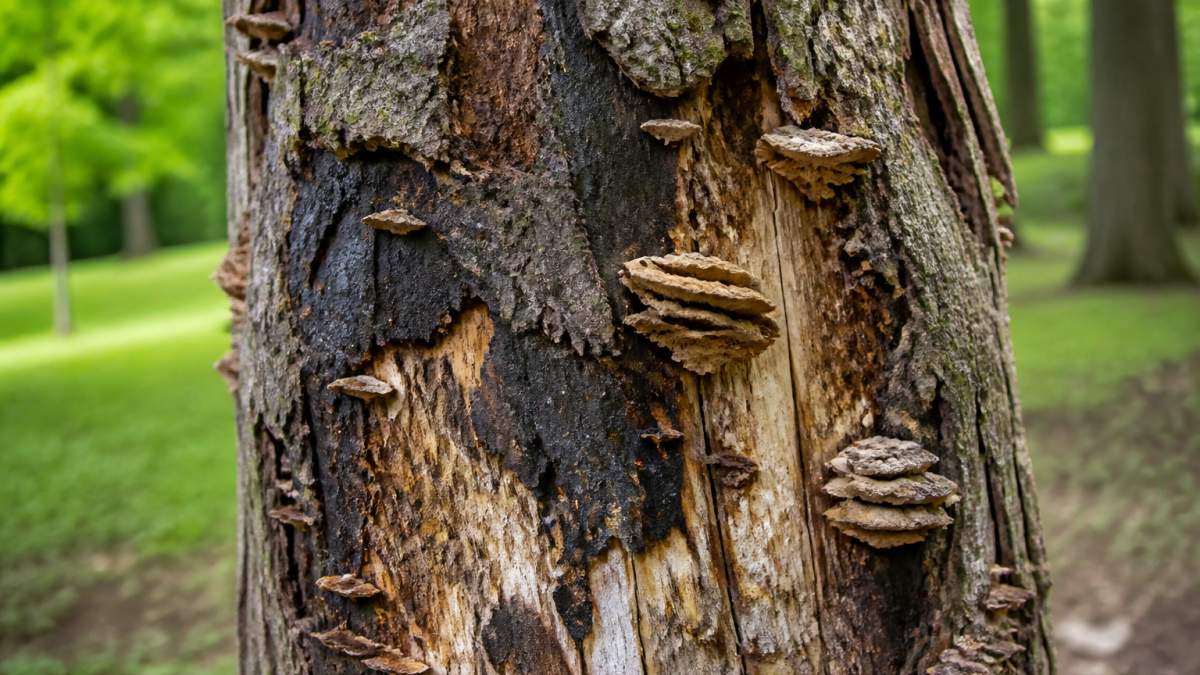
Certain symptoms indicate a tree has moved past recovery. Understanding the difference between stress and death is critical to deciding whether removal is necessary.
Crown dieback affecting more than 50% of the canopy indicates decline. Complete defoliation during the growing season means the tree is likely dead or dying.
Bark condition is telling. Healthy bark is intact and firmly attached.
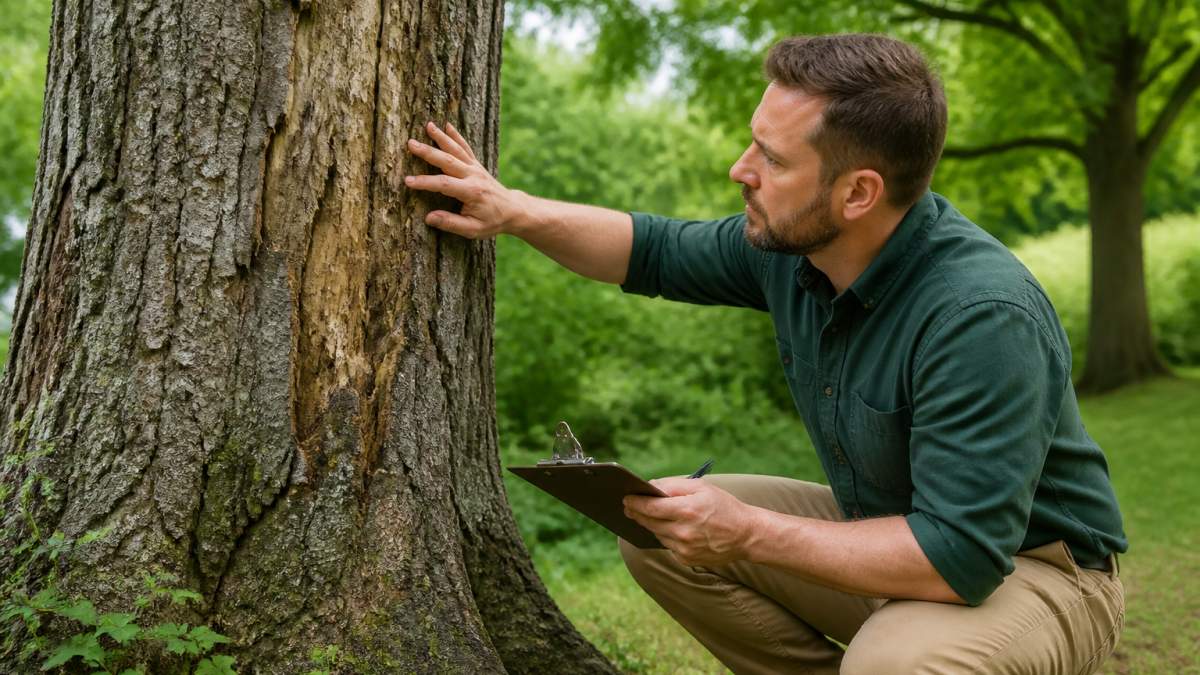
Trunk wounds and cavities are serious. A deep cavity or large wound indicates internal decay is likely present.
Fungal fruiting bodies (mushrooms or shelf fungi) indicate advanced decay. A mushroom near the base is more concerning than one high on the trunk, as it suggests root system decay.
Trunk, Bark, and Root System Assessment
The trunk is the tree's main structural support and vascular highway. Check for cracks, splits, or deep gouges. A crack halfway around the trunk is more serious than a small vertical split.
Co-dominant stems (two or more main trunks of similar size from the same point) create structural weakness. In storms, these trees split apart more easily.
Root flare is where roots spread from the trunk base.
Soil compaction restricts root growth and water penetration. Hard, crusty soil or pooling water indicates struggling roots.
Look for exposed roots, heaving soil, or tilting, signs of root problems. A tree that has recently started to lean may be losing root anchoring.
Tree Disease Identification Guide and Fungal Signs
Many tree diseases are difficult to diagnose without expertise. Diseases fall into fungal infections, bacterial cankers, and viral disorders, fungal diseases are most common. The diseases you encounter depend heavily on your climate and region.
Regional Disease Patterns
In humid climates (Southeast, Midwest, Northeast): Fungal diseases thrive in moisture and poor air circulation. Watch for:
- Anthracnose (dark spots on leaves and twigs, twig dieback): Common in sycamore, oak, and dogwood. Appears in spring during wet weather.
- Powdery mildew (white coating on leaves): Indicates poor air circulation; prune to open the canopy.
- Leaf spot diseases (brown or black spots with yellow halos): Weakens the tree if severe and repeated year after year.
- Root rot and Phytophthora (sudden wilting, cankers at the base): More likely in poorly drained soil or after heavy rainfall.
In arid and semi-arid climates (Southwest, High Plains): Drought stress and pest pressure dominate. Watch for:
- Drought stress symptoms (early leaf drop, thinning crown, branch dieback): Often precedes pest infestation. Trees stressed by drought are more susceptible to bark beetles and other insects.
- Sunscald and frost crack (vertical cracks in the trunk, especially on the south-facing side): Common in winter when temperature swings are extreme.
- Mistletoe infestation (clumps of green growth in branches): Parasitic and weakens the tree over time.
- Cytospora canker (oozing cankers on conifers, especially spruce and fir): Often follows drought or winter injury.
In temperate climates with cold winters (Northern regions):
- Winter injury and salt damage (branch dieback, bark splitting): From road salt, de-icing chemicals, or extreme cold.
- Verticillium wilt (one-sided wilting and decline): Affects maples, elms, and ash; no cure.
- Ash yellows and Emerald ash borer (rapid decline in ash trees): Emerald ash borer has killed millions of ash trees across the country; if you have ash trees, monitor closely.
Common Fungal and Bacterial Signs (All Regions)
Cankers are dead areas of bark and wood, usually oval or elongated. They're caused by fungi or bacteria that invade through wounds or natural openings.
Leaf spots and blights appear as dark spots, yellowing, or premature leaf drop. While these are often cosmetic, severe defoliation year after year weakens the tree.
Powdery mildew looks like a white coating on leaves and twigs.
Rust appears as orange or yellow pustules on the undersides of leaves. It's rarely fatal but indicates stress.
The most serious fungal infections are those affecting the vascular system. Verticillium wilt and Dutch elm disease are systemic; they clog the tree's water transport system.
Necrosis, death of tissue, appears as sunken, darkened areas on bark or wood. This indicates the tree's defense system is being overwhelmed. Large areas of necrosis suggest advanced infection.
Fungal Fruiting Bodies: The Most Serious Sign
Fungal fruiting bodies (mushrooms or shelf fungi growing from the trunk or roots) are a sign of advanced decay. These organisms are decomposing the tree from inside. Their presence means the damage is substantial. A single mushroom near the base is more concerning than one high on the trunk, as it suggests decay in the root system. If you see fruiting bodies, the tree has likely been infected for years and internal decay is extensive. This is a professional assessment situation.
Arborist Tree Inspection Cost and When to Call a Professional
Knowing when to call a professional is as important as knowing what to look for. A certified arborist can diagnose diseases you can't see, assess structural risk, and recommend treatments or removal with confidence.
The DIY vs. Professional Risk Threshold
Safe for homeowner inspection:
- Trees under 30 feet tall, fully accessible from the ground
- No visible structural defects (no cavities, deep cracks, or missing bark)
- No signs of active pest infestation or fungal fruiting bodies
- Tree is not leaning, and no branches are visibly broken or hanging
- Tree is at least 10 feet from structures, power lines, or property lines
- You have binoculars to inspect the crown without climbing
Stop inspecting and call a professional immediately:
- The tree is leaning noticeably or has recently started to tilt
- You see large cavities (larger than your fist) in the trunk
- More than 50% of the crown shows dieback or is missing foliage
- Bark is missing in patches larger than your hand, or you see exposed wood
- Fungal fruiting bodies (mushrooms or shelf fungi) are present on the trunk or at the base
- The tree is within 15 feet of your house, a neighbor's house, or power lines
- You see signs of root damage: heaving soil, exposed roots, or the tree is tilting
- You lack a clear view of the entire crown or the tree is over 40 feet tall
- You feel uncertain about what you're seeing
A tree with structural defects can fail without warning. Climbing or using a ladder to inspect a compromised tree puts you at serious risk. The cost of a professional assessment ($150-$400) is far less than the cost of a fall, property damage, or liability.
When to Hire a Certified Arborist
A certified arborist holds ISA (International Society of Arboriculture) credentials and has passed rigorous exams on tree biology, pruning, pest management, and safety.
Call a certified arborist if:
- The tree shows signs of significant disease (cankers, dieback, leaf spots affecting more than 25% of the crown)
- Large branches are dead or dying
- The trunk has deep wounds, cavities, or large areas of missing bark
- The tree is leaning or has recently started to tilt
- You see fungal fruiting bodies on the trunk or roots
- The tree is near your house, a neighbor's property, or other structures
- You're uncertain about the tree's condition and want a professional opinion
- The tree has been damaged by a storm and you're unsure of its stability
- You want to know if pruning, cabling, or other interventions might save the tree
A certified arborist can recommend pruning, cabling, or other interventions to save a tree not yet beyond recovery. They follow ISA standards and can use tools like a resistograph (measuring wood density) or sonic tomograph (mapping internal defects) to assess hidden damage.
Post-Storm Assessment and DIY vs. Professional Risk Thresholds
After a major storm, many trees sustain damage that requires immediate assessment. Broken branches, stripped bark, and uprooted trees are obvious.
Minor damage includes small broken branches (less than 2 inches) that don't threaten structures or power lines.
Moderate damage includes larger broken branches, significant bark stripping, or partially uprooted trees. If the tree is near your house, power lines, or a neighbor's property, hire a professional.
Severe damage, completely uprooted, snapped at the trunk, or leaning dangerously, requires immediate professional response. A tree in this condition can fail without warning and cause serious injury or property damage.
If you're uncertain, don't do it. If the tree is large, near structures, or you lack proper equipment or experience, call a professional.
Assessing tree health is a skill that pays dividends over time. If you've identified signs of disease, structural problems, or storm damage on your trees, don't wait. Red Woodpecker Tree Service provides professional tree inspection, diagnosis, and removal with certified arborists, modern equipment, and 24/7 emergency response.
Frequently Asked Questions
What is the 10/20/30 rule for trees?
The 10/20/30 rule is an arboricultural standard for structural diversity: no single tree species should comprise more than 10% of your landscape, no single genus more than 20%, and no single family more than 30%. This reduces vulnerability to pests and diseases that target specific tree types. When assessing tree health across your property, this rule helps you identify whether you have healthy diversity or risk concentrating problems through monoculture planting.
How much does a professional tree health assessment cost?
Professional arborist tree inspection costs vary based on property size, number of trees, and complexity of assessment. Most certified arborists charge hourly rates or flat fees per inspection. Red Woodpecker Tree Service offers free estimates to evaluate your trees and recommend next steps. Contact us for a quote tailored to your specific needs and property size.
When should I hire a certified arborist for a tree inspection?
Hire a certified arborist when you notice signs of disease, significant structural damage, pest activity, or after severe weather events. Also consider professional assessment if trees are near structures, power lines, or property lines, or if you're uncertain about a tree's safety. A certified arborist has formal training in tree biology and risk assessment that homeowners typically lack, making professional evaluation essential for hazardous situations.
Can I use an app to check the health of my trees?
Several apps can help identify tree species and common diseases by analyzing photos of leaves, bark, or symptoms. However, apps have limitations: they cannot assess structural integrity, soil compaction, root health, or overall vigor the way an in-person inspection does. Use apps as a first screening tool, but rely on a certified arborist for comprehensive health assessment, especially if you're considering removal or treatment.
What are the primary signs that a tree is dying?
Key indicators include extensive crown dieback (dead branches throughout the canopy), significant foliage loss or yellowing, large sections of missing or peeling bark, fungal fruiting bodies on the trunk, and minimal new growth. A dying tree may also show girdling roots, deep cavities, or multiple cankers. If more than 50% of the canopy is dead or the tree shows multiple critical symptoms, professional removal may be necessary for safety.
What environmental stressors should I watch for when assessing tree health?
Common stressors include soil compaction around the root flare, drought stress (leaf scorch, premature defoliation), waterlogging, extreme temperature fluctuations, and nearby construction or root damage. Pollution, salt spray, and improper pruning also weaken trees. Climate-specific stressors vary: in drier regions, drought sensitivity increases; in humid areas, fungal diseases and pest pressure rise. Identifying stressors helps determine whether a tree can recover or requires removal.