 comparison
How Much Does Stump Grinding Cost in the United States?
Last Updated: November 2, 2026
Quick Summary
Stump grinding cost in the United States typically falls between $120 and $400, with Angi reporting a 2026 national average of $250. Your actual stump grinding cost depends on stump diameter, wood type, and site access, so treat national averages as a rough benchmark rather than a final quote.
- Many contractors price by stump diameter, often estimated at $2 to $5 per inch for softwood.
- Hardwood stumps cost more to grind, at roughly $3 to $7 per inch, because the wood is denser.
- Many companies set a minimum visit charge of $100 to $200, which can outweigh per-inch math on small jobs.
- Chip haul-away and backfilling the hole are often separate line items, so ask for them itemized.
- Grinding is usually cheaper than full stump removal, which costs $300 to $1,000 according to Woodland Mills.
Table of Contents
- What Stump Grinding Typically Costs
- Cost Per Inch: How Contractors Price by Diameter
- Sample Quotes With Job Details
- Stump Grinding vs. Stump Removal: What You Pay For
- How Long Stump Grinding Takes
- What Affects Your Stump Grinding Estimate and What a Quote Includes
- Get a Written Estimate for Your Stump Before You Book
- Frequently Asked Questions
What Stump Grinding Typically Costs
Stump grinding is one of the most common tree service requests we see, and the price question comes up first for almost every homeowner. At Red Woodpecker Tree Service, we know how frustrating it is to collect quotes that seem to range wildly. Stump grinding cost depends on the size of the stump, its wood type, and how hard the crew must work to reach it.
Published national figures give a general reference point. Angi reports a 2026 national average of $250 for stump grinding, and says most homeowners pay between $120 and $400 (Angi stump grinding cost guide). LawnStarter reports a range of $131 to $438 (LawnStarter stump grinding price guide). Those averages are a starting benchmark, not a quote for your yard.
Your actual stump grinding cost will depend on local labor rates, equipment access, and the scope of work. Treat any national average as a rough check on your quote, not a final number.
Cost Per Inch: How Contractors Price by Diameter
Many contractors price stump grinding by the diameter of the stump, measured across the cut surface. A wider stump takes more passes with the grinder, so the labor and machine time rise with size. Stump diameter is the single factor most estimates start with.
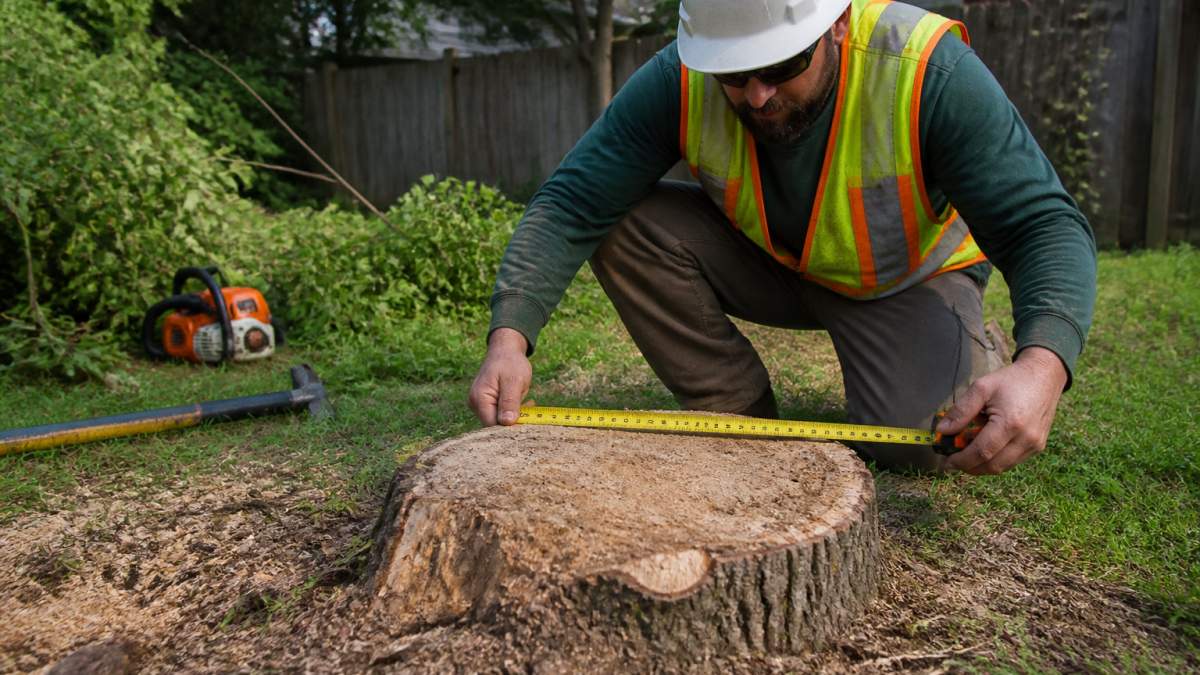
Per-inch pricing is an estimating method, not a universal rule. One online calculator reports $2 to $5 per inch of diameter for softwood and $3 to $7 per inch for hardwood (MulchDeck stump grinding cost calculator). Applied to a 24-inch stump, that method would produce a range of roughly $48 to $120 for softwood and $72 to $168 for hardwood. Those figures are a guide to how the math works, not a price we quote.
Softwood vs. Hardwood Per-Inch Rates
Hardwood stumps cost more to grind because the wood is denser and wears down the cutting teeth faster. Oak, hickory, and maple take longer to grind than pine or cedar of the same diameter. Ask your contractor whether the quote accounts for wood type. A quote that ignores species can understate the true job.
Minimum Visit Charges on Small Jobs
Many companies set a minimum charge per visit, because a crew cannot profitably make a trip for one small stump. Calculator data puts that minimum at $100 to $200 per visit (MulchDeck stump grinding cost calculator). If you have a single small stump, the minimum may outweigh the per-inch math. Ask whether multiple stumps on the same visit reduce the per-stump price.
Sample Quotes With Job Details
| Line item | Small backyard stump | Mid-size oak stump | Large stump near fence |
|---|---|---|---|
| Diameter measured at cut | 12 inches | 24 inches | 36 inches |
| Wood type assumed | Pine (softwood) | Oak (hardwood) | Oak (hardwood) |
| Access | Open lawn, gate wider than 36 inches | Standard gate, 8-foot carry to turf | Tight side yard, 4-foot gate, grind in place |
| Per-inch rate applied | $2-$5/in (softwood) | $3-$7/in (hardwood) | $3-$7/in (hardwood) |
| Diameter-based subtotal | $24-$60 | $72-$168 | $108-$252 |
| Minimum visit charge | $100-$200 applies | Not triggered | Not triggered |
| Extra passes / hand work | None | +1 pass for density | +2 passes, hand-guided head |
| Mobilization | Included in minimum | $0-$75 typical | $0-$75 typical |
| Chip haul-away (optional) | $0 (chips left) or $40-$75 | $0 or $60-$120 | $0 or $90-$150 |
| Backfill with soil (optional) | $25-$50 | $50-$100 | $75-$150 |
| Estimated all-in range | $100-$200 | $150-$350 | $275-$550 |
A quote should show the diameter measured, the wood type assumed, the access conditions, whether a minimum charge applies, and which optional line items are included. A quote that gives one lump sum with no detail makes it hard to compare offers.
Stump Grinding vs. Stump Removal: What You Pay For
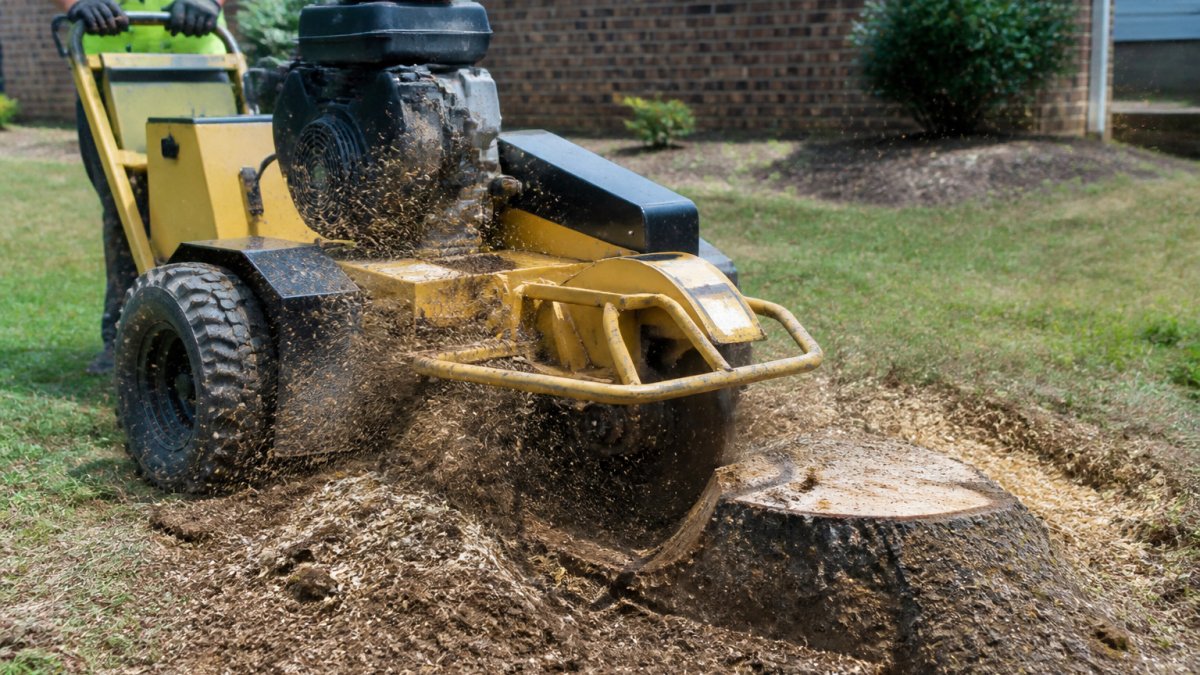
Stump grinding and full stump removal solve different problems. Grinding reduces the stump to wood chips and mulch, usually 6 to 12 inches below ground level. Full removal digs out the stump and the major roots, which costs more and creates a bigger hole to fill.
Woodland Mills reports stump grinding averages of $175 to $475, and complete stump removal of $300 to $1,000 (Woodland Mills stump grinding cost guide). Grinding is usually the lower-cost choice when you plan to plant grass or build over the spot. Full removal may be worth the extra cost if you need the ground fully cleared for construction.
How Long Stump Grinding Takes
Single-stump jobs take varying amounts of time on site, depending on size and access. Large stumps or stumps wrapped in roots can take longer. Crews also spend time setting up equipment, protecting the lawn, and clearing chips afterward. Ask your contractor for an estimated timeline, and confirm whether cleanup is included.
What Affects Your Stump Grinding Estimate and What a Quote Includes
Several factors move the final number, and the ones that surprise homeowners most are the ones buried in the fine print of a quote. Diameter and wood type matter most, but access, stump count, grinding depth, and what happens to the chips and the hole often swing the total by more than the per-inch rate does.
The factors that move the price
- Diameter and wood type. A wider stump means more passes; denser hardwood wears teeth faster and slows the cut. These two set the baseline.
- Access and site difficulty. A stump behind a fence, beside a deck, on a slope, or in a tight side yard forces hand work or a smaller grinder. Expect a labor premium when the machine cannot park within a few feet of the stump.
- Stump count. Multiple stumps on one visit usually cost less per stump because mobilization and setup are shared. Ask for a per-stump price at 1, 3, and 5 stumps so you can see the discount.
- Grinding depth. Standard grinding goes 6-12 inches below grade. Deeper grinding for replanting or construction costs more because it takes more passes and more time.
- Underground utilities and nearby structures. The crew must locate utilities before grinding, and must protect fences, siding, and irrigation heads. This is a safety step, not an upsell, but it can add setup time.
What a quote should include, and what it often excludes
A complete quote states its scope in writing. Use this checklist when you compare bids:
- Grinding depth, stated in inches below grade, not just "ground out."
- Wood chip removal, leaving chips on site is usually free; hauling them away is typically a separate line item.
- Backfilling the hole, some contractors leave the cavity open; others backfill with soil or grindings for an added fee.
- Debris cleanup and yard restoration, raking, turf repair, and hauling off excess grindings.
- Utility locating and property protection, confirm the contractor calls for utility marking before grinding and carries liability coverage for nearby structures.
- Mobilization fee or minimum service charge, ask whether either applies and how it changes with multiple stumps.
- Taxes and permits, rarely included in advertised ranges; confirm whether either applies in your area.
Roots, regrowth, and the hole left behind
Grinding removes the stump and the roots within the grinding depth, but it does not remove the root system. Surface roots may remain, and some species, particularly willows, poplars, and certain maples, can send up sprouts from roots left in the ground. Ask how the contractor handles sprouts and whether a herbicide application or a second pass is recommended. The cavity itself may settle over time as the remaining grindings and roots decompose, so plan to top off the hole with soil, especially if you intend to plant grass or a garden over the spot.
Post-grinding restoration: the cost after the cost
Budget for restoration separately, because it is rarely bundled into a grinding quote. Removing chips, bringing in topsoil, and seeding or sodding the patch are separate costs that depend on volume, stump size, and whether you do the work yourself or hire it out. Replanting, a shrub, a small tree, or a garden bed, is a separate project entirely.
Grinding versus removal, compared on more than price
Grinding is usually the lower-cost choice when you plan to plant grass or build over the spot, and it leaves the root system largely in place. Full removal digs out the stump and major roots, costs more, and creates a larger hole to fill, but it is the right call when you need the ground fully cleared for construction, a driveway, or a foundation. Compare the two on total cost, disruption, equipment access, root removal, and the end use of the space, not on the headline price alone. The cheaper option is only cheaper if it solves the problem you actually have.
Get a Written Estimate for Your Stump Before You Book
Before you book, measure the stump diameter and note the wood type if you know it. Then request a written estimate that lists the scope, access conditions, cleanup, and any minimum charge. Red Woodpecker Tree Service provides free estimates. For current pricing on your property, contact Red Woodpecker Tree Service for a quote.
Frequently Asked Questions
How much does it cost to grind a tree stump?
Final pricing depends on stump diameter, wood type, depth, and site access. Ask for a written quote that lists the stump measurements and any minimum charge so you can compare bids on the same basis.
How long does it take to grind a 10 inch stump?
The time a 10-inch stump takes depends on setup, cleanup, and access as well as grinding itself. Hardwood stumps take longer than softwood stumps of the same diameter because the wood is denser. Crews usually want to clear the site of debris and backfill with soil after grinding. Ask your provider to estimate total time on site, not only grinding time.
Can you grind a stump yourself?
Homeowners can rent a stump grinder, but rental fees, transport, and safety gear add cost, and inexperienced operators risk injury and damage to buried utilities. Grinding also requires cutting the stump below the soil line and handling large debris. Before you dig or grind, call 811 to have underground utilities marked. For most homeowners, hiring a trained and certified arborist with insurance is the safer choice.
Is stump grinding cheaper than stump removal?
Yes, in most cases. Stump grinding is usually the lower-cost option, and grinding leaves the roots in the ground and grinds the stump to below the surface, which is why it costs less. If you plan to plant over the site, discuss whether grinding depth and remaining roots will work for your project.